
Website design for custom home builders & remodelers in Northeast Florida
Buyers in Palencia, Hammock Dunes and Plantation Bay compare builders online before they ever call. What your portfolio, process pages and community pages need to win that comparison.
A custom home builder or remodeler sells two things before anyone signs: proof of craft and confidence in the process. The website's job is to deliver both before the first phone call, because the people researching a custom build or a major remodel in Northeast Florida do a lot of quiet comparison first. This post covers what actually belongs on a builder's or remodeler's website, from the portfolio to the service-area pages, based on how buyers in this region shop. For the service itself, see our web design for home builders and real estate page.
Your market is communities, not just cities
From St. Augustine down through Palm Coast and the Ormond Beach side of the Daytona area, custom building and remodeling demand concentrates in specific communities: established golf and gated neighborhoods like Palencia and World Golf Village in St. Johns County, Hammock Dunes, Grand Haven and Palm Coast Plantation in Flagler County, and Halifax Plantation and Plantation Bay around Ormond Beach. Homeowners in these places search differently. They do not just search “remodeler near me”; they look for someone who has worked in communities like theirs, understands architectural review boards and HOA approvals, and builds to the standard the neighborhood expects. A website that speaks only in city names misses how this market thinks.
The portfolio is the homepage
Nothing on a builder's site outranks the work. Treat the portfolio as the center of the site, not a page off the menu:
- Large, fast, professional photos. Phone snapshots undersell high-end work. Compress properly so galleries stay fast; slow galleries lose exactly the patient, high-intent visitors you want.
- Organize by what buyers want to see: whole-home builds, kitchen and bath remodels, outdoor living, additions. Let someone planning a kitchen get to kitchens in one click.
- Tell each project's story. A short writeup per project, the challenge, the scope, the result, outperforms a bare image dump and gives search engines something to rank.
- Show the range honestly. Only show work you can repeat, because the portfolio sets the expectation every lead arrives with.
Process pages calm the fear that kills deals
Custom builds and major remodels are among the most stressful purchases a homeowner makes, and most of the fear is about the unknown: how long, what order, who shows up, what happens when something changes. A clear process page, from consultation and design through permitting, construction and walkthrough, answers that fear before the first meeting. Builders skip this page because the process feels obvious to them. It is not obvious to the buyer, and the builder who explains it looks more organized than the one who does not. Pair it with pages about how you handle selections, allowances and change orders in plain language, and the first meeting starts warmer.
Service-area pages, done with real substance
If you build or remodel across several communities, each major one deserves its own page, and not a find-and-replace template. A worthwhile community page says something true: the style of homes there, the kinds of projects you take on there, how you work with that community's review process. Thin, duplicated pages do little; substantial ones give you a presence for searches with a community's name in them and give a homeowner the feeling you know their street. This is the same approach we take on our own location pages for St. Augustine, Palm Coast and Ormond Beach.
Proof: credentials, reviews and the details that signal quality
- License number visible in the footer; buyers in this market check
- Insurance, association memberships and any certifications, stated plainly
- Google reviews pulled through or quoted with permission, kept current
- Named team members with photos; people hire people for year-long projects
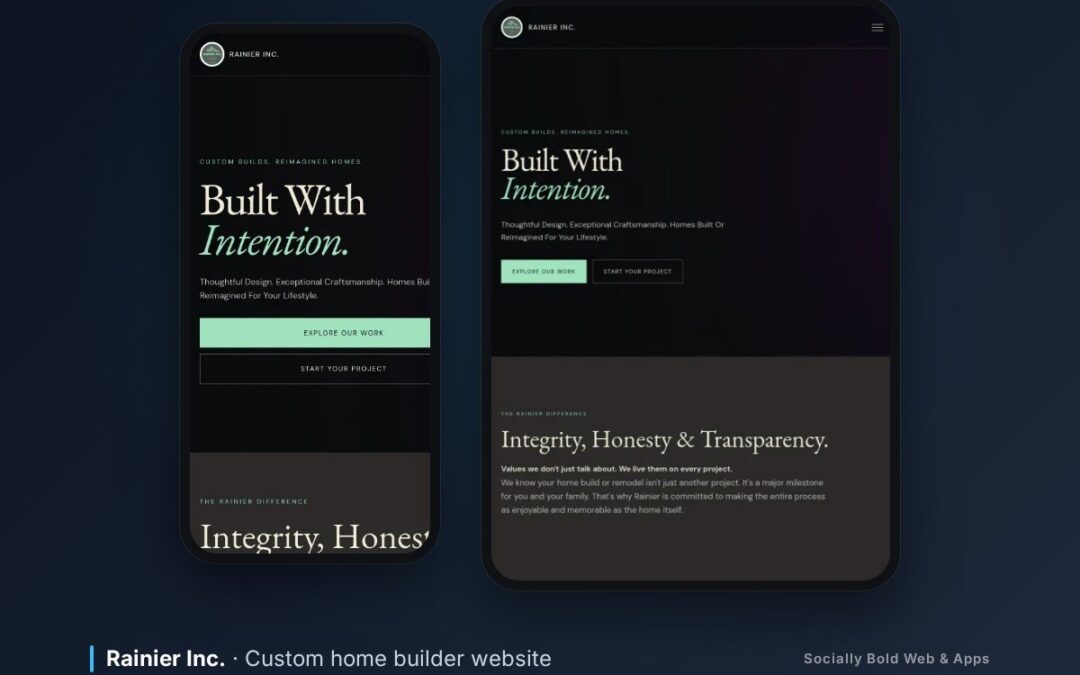
The site's own design quality is part of the proof. A buyer researching a high-end remodel reads a dated, slow, template-looking website as a signal about attention to detail. It is not fair, but it is how judgment works when all the buyer can see is the website. One example of this done deliberately: the site we built for Rainier Inc., a Jacksonville custom home builder, leads with full-width project photography and a clear process; the Rainier case study shows the thinking.
The quiet technical layer
Behind the photography, a builder's site needs the same fundamentals as any lead-generation site: fast loading on phones, a contact path on every page, schema markup so search engines understand the business and its service area, and analytics that show which communities and project types actually drive inquiries. Forms should ask for the project type and general location, enough to route the conversation, not so much that the form feels like an application.
A checklist before you brief any designer
- Portfolio organized by project type, with professional photography and short writeups
- A process page that walks a buyer from first call to final walkthrough
- A substantial page for each major community you serve
- License, insurance and reviews visible near every call to action
- Mobile speed verified, not assumed
- A clear, short inquiry form plus a phone number that gets answered
If your current site has the photos but not the structure, or the structure but five-year-old photography, that is a normal starting point. Tell us what you build and we will give you an honest read on what the site needs; every project is scoped individually.
Frequently asked questions
What should a custom home builder's website include?
At minimum: a portfolio organized by project type with professional photography, a clear process page, pages for the communities you serve, visible license and insurance details, current reviews, and a fast mobile experience with a simple inquiry form.
Do remodelers really need separate pages for each community they serve?
For the major ones, yes, provided each page says something real about your work there. Substantial community pages help you appear for searches that name the community and show homeowners you know their area. Thin duplicated pages help nobody.
How important is photography on a builder website?
It is the deciding factor. Buyers comparing builders judge craft through photos before they ever call. Professional photography of finished projects consistently outperforms phone snapshots, and galleries must stay fast or visitors leave before seeing them.
What is a process page and why does it matter?
A page that walks a prospective client through how a project runs, from consultation and design through permitting, construction and walkthrough. It answers the anxiety that stalls custom projects and positions you as the organized choice before the first meeting.
Can a good website guarantee more custom home leads?
No. A well-built site reliably converts more of the buyers who find it, but nobody can guarantee lead volume or rankings, and you should be wary of anyone who does. The site is one part of a system that includes search visibility, reviews and referrals.
Do you work with builders outside Jacksonville?
Yes. We are a Jacksonville agency and can build websites for businesses that serve the St. Augustine, Palm Coast, Flagler County and Ormond Beach areas, mostly by video call, with in-person meetings when they help.